


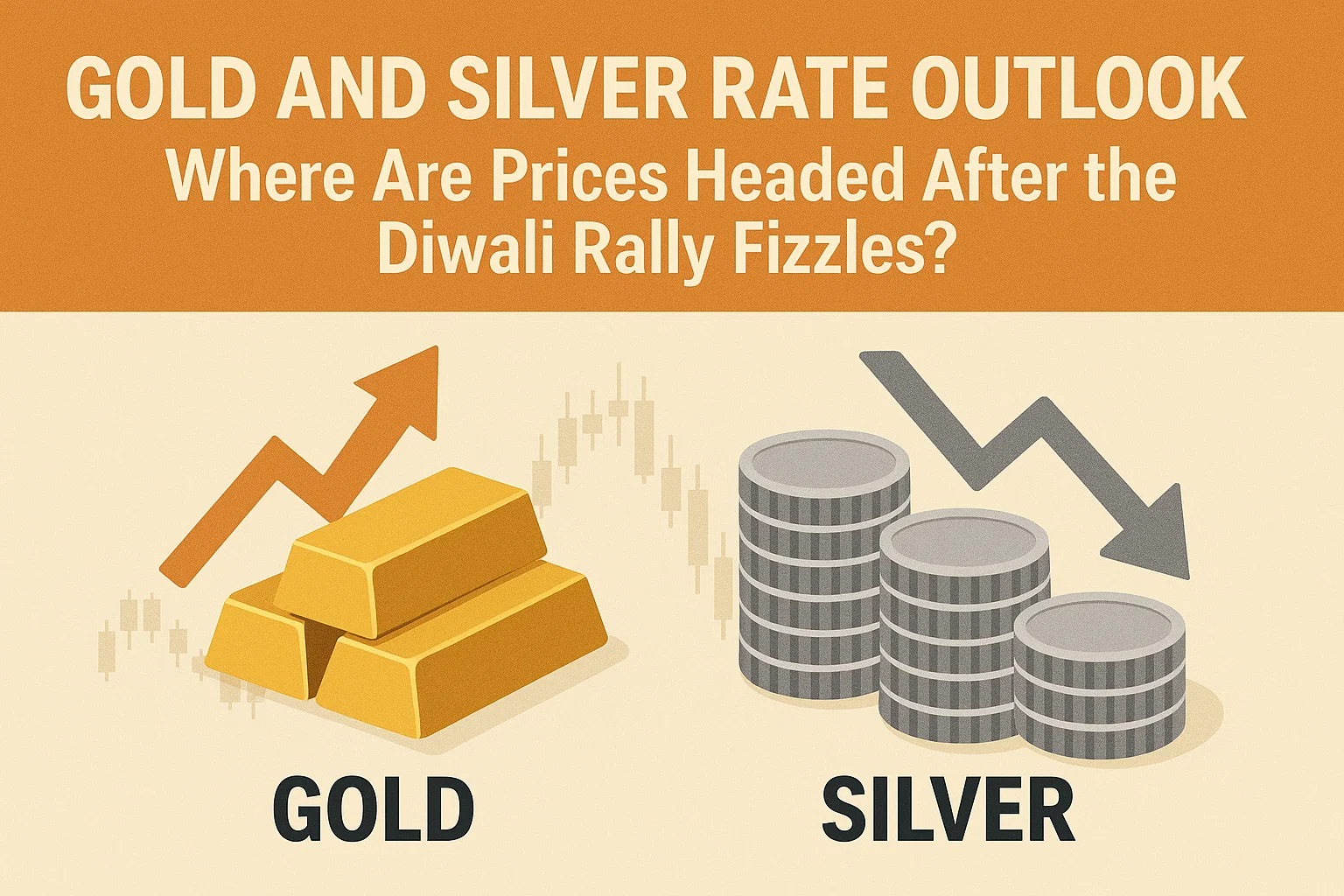
The recent sharp rally in bullion — both gold and silver — has caught the attention of investors, analysts and consumers alike. As the festive season peaks in India and global markets adjust, the question is: what lies ahead for precious metals? This is the story of the gold and silver rate outlook, especially after the post-Diwali pullback, and it’s crucial for anyone tracking bullion rates, investment decisions or simply watching where the next move in gold and silver might go.
Introduction
Over the past year, gold and silver have enjoyed strong upward momentum. In India, 24-karat gold surged from around ₹75,000 per 10 grams to nearly ₹1.30 lakh per 10 grams — an extraordinary jump. On the global front, gold has been pushed higher by geopolitical tensions, de-dollarisation trends and central bank buying. As one expert put it, the recent pull-back in the yellow metal was expected after such an extended rise.
But does a correction mean the long-term trend is broken? That’s where the gold and silver rate outlook comes in. Despite the recent dip, analysts believe the underlying strength remains intact. The aim of this article is to dig into that outlook, map the key drivers, discuss the levels to watch for both gold and silver, and help you make sense of what might happen next.
1. The Recent Bull Run — What Happened?
To understand where things are headed, let’s first recap how we got here.
-
In India, gold (24 K) moved from roughly ₹75,000 per 10 g to around ₹1.30 lakh per 10 g, i.e. a rise of about ₹55,000 over the year.
-
On the global stage, gold has crossed USD 4,000 per ounce in some analyses and is being forecast for still higher levels by major banks. For example, J.P. Morgan sees an average of USD 3,675/oz by Q4 2025 and a move toward USD 4,000/oz by mid-2026.
-
Silver, meanwhile, has rallied strongly — nearly doubling in some markets over the last year, supported by both investment demand and industrial demand (especially for green technologies and electronics).
-
According to reports, despite the rally, the recent decline in both metals was anticipated — as one major jewellery industry body pointed out, gold had run one-sided for months and a correction was a natural part of the cycle.
The upshot: The rally set up high expectations; now the market is assessing levels, pull-backs, and the next leg of the move. Hence the significance of looking at the gold and silver rate outlook at this juncture.
2. Why the Pull-back? Understanding the Correction
After a strong rally, it’s common for precious metals to pause, consolidate, or correct somewhat. Some of the reasons behind the recent dip:
-
Profit booking: Traders and investors often lock in gains after a prolonged move. For example, after Diwali in India, bullion traders often book profits before the seasonal lull.
-
Technical exhaustion: After sustained rise, overbought conditions may invite a pause or a mild reversal.
-
Macro-winds changing: A firmer U.S. dollar, rising real interest rates, or signs of global economic recovery can dampen precious metal demand temporarily.
-
Industrial/consumer demand shifts: Especially in silver’s case, any moderation of industrial demand or delay in projects may prompt pull-backs.
What the correction does not necessarily mean is that the bull trend is over. Rather, many analysts view it as a pause or consolidation phase, before the next upward move. In the words of one India-based commodity strategist: “There could be a bit more pressure ahead… but a free fall is unlikely.”
3. Key Drivers Shaping the Gold and Silver Rate Outlook
Here we look at the major factors that will influence prices in the medium to long term for gold and silver.
3.1 Demand from Central Banks & Safe-Haven Flows (Gold)
Gold’s appeal as a reserve asset is well documented. Central banks continue to buy gold as part of their reserve diversification strategies.
In times of geopolitical stress, market uncertainty or inflation concerns, gold typically benefits from safe-haven demand. For example, de-dollarisation trends in some countries, or trade wars, have boosted appeal for gold.
3.2 Industrial Demand (Silver)
Unlike gold, silver has a double role: it’s a precious metal and an industrial metal. Much of silver’s demand comes from solar panels, electronics, EVs, and other industrial uses.
This gives silver a structural demand base that differs from gold — so the silver rate outlook has an additional layer of industrial consumption behind it.
3.3 Supply Constraints & Deficits
Limited new supply, especially for silver (often mined as by-product of other metals), and ongoing deficits in the market contribute to bullish underpinnings. For instance, supply deficits for silver have been highlighted in recent market reports.
Similarly for gold, while supply is more steady, the incremental support from central bank buying and jewellery demand keeps supply-demand dynamics tight.
3.4 Inflation, Currency, Interest Rate Dynamics
Precious metals are sensitive to real interest rates, strength of the U.S. dollar, inflation expectations. When real yields fall (or negative), non-yielding assets like gold and silver become more attractive.
Likewise, a weaker dollar tends to push bullion higher because it becomes cheaper in other currencies.
3.5 Geopolitical Risks, Trade Tensions, De-dollarisation
Events such as trade wars, tariffs, sanctions, de-dollarisation efforts all feed into the safe-haven narrative. For example, many large exporters/ importers converting dollar-receipts into gold. These themes support the gold and silver rate outlook over the medium term.
3.6 Seasonal & Regional Demand (India)
India plays a major role in bullion demand, both for gold jewellery and investment. Post-festive seasons, Diwali, wedding seasons all matter. But after big rallies, some traders may book profits — a dynamic seen in recent weeks.
4. Table: Gold & Silver Rate Outlook — Key Levels and What to Watch
Below is a summary table of critical levels, potential correction bands, and trigger factors for gold and silver. It’s not a prediction but a framework for monitoring.
| Metal | Current Approx Level* | Possible Pull-back / Support Zone | Key Factors to Watch | Bullish Scenario | Bearish/Sideways Scenario |
|---|---|---|---|---|---|
| Gold | ~ USD 4,100/oz globally; in India ~ ₹1.25-1.26 lakh/10 g (24 K) | Correction maybe USD 50-100/oz globally; in India maybe ₹1.25 lakh | Central bank buying, dollar strength, rate decisions | Break above USD 4,200/oz (India above ~₹1.30 lakh) if safe-haven flows intensify | Consolidation around current levels; pull-back to support if macro improves |
| Silver | Double-digit rise (~85%+ YTD in India) | Support zone around India ~ ₹1.40 lakh per kg; globally correction ~10-20% | Industrial demand, supply deficits, dollar & rate data | Silver catches up or outperforms gold as industrial demand surges | Weakening industrial demand or strong dollar weakens silver momentum |
* Based on recent commentary and market data in India and internationally.
This table offers a quick reference for the gold and silver rate outlook — where things stand now, what levels to monitor, and how key drivers might influence the next move.
5. Short-Term vs Medium/Long-Term Outlook
Short-Term (next 1-3 months)
-
Possible modest pull-back or consolidation after the recent rally.
-
For gold, some analysts expect another small drop (e.g., USD 50-100/oz globally) but not a deep fall because the fundamentals remain intact.
-
For silver, the correction could be a bit sharper or more volatile given its dual role and higher sensitivity to industrial/ demand shifts.
-
In India, post-Diwali seasonal profit booking may weigh on rates, but festival/wedding demand may also provide support.
Medium to Long-Term (6 months to 2 years)
-
For gold, the structural bull case remains strong: diversified demand, central bank purchases, safe-haven flows. Many major banks forecast new highs.
-
For silver, the industrial demand story is compelling — green energy, electronics, EVs — suggesting a strong underlying outlook.
-
As bullion rates move higher region-by-region (India, China, Middle East), local currency and domestic factors (import duties, tax regimes) will play a role in India’s rate outcome.
6. The India Specific Angle
India is unique in its gold & silver market dynamics:
-
Cultural jewellery demand remains strong for gold.
-
Silver sees strong demand in investment, industrial and traditional silverware use.
-
Import duties, local taxes, rupee/dollar movements, and festival seasonality all matter.
-
Recent commentary from Indian industry bodies suggested that the recent correction in gold was expected given the sharp run-up.
-
Given India’s large weight in global bullion demand, domestic factors will influence the gold and silver rate outlook in India more than purely global rates.
7. Investment Considerations for Bullion Investors
If you are considering buying, holding or reducing exposure in gold or silver, the following points matter:
-
Understand whether you are investing for short-term speculation (e.g., next 3-6 months) or medium/long-term hedge.
-
Given the recent rally, you may want to use pull-backs as opportunities rather than chasing the top.
-
Silver is more volatile than gold — it may offer higher upside but also higher risk (especially industrial demand risk). Some analysts caution that silver is riskier than gold even amid strong upside.
-
Keep an eye on macro variables: real interest rates, dollar strength, central bank flows, geopolitical risks.
-
In India especially, consider taxes, import duties, domestic supply/demand cycles, and parity with global rates.
8. Risks and Things That Could Go Wrong
No outlook is perfect, and for the gold and silver rate outlook we must note the risks:
-
If the U.S. Federal Reserve tightens more aggressively than expected, real yields may rise, hurting non-yielding assets like gold/silver.
-
If the U.S. dollar strengthens, bullion may face pressure.
-
If global industrial demand for silver slows (e.g., slowdown in solar/EV demand), silver could underperform.
-
If global geopolitical tensions ease markedly, safe-haven demand might decline.
-
For India: any change in import duties/taxes, rupee depreciation, or local policy may override global influences.
9. What to Watch Next — Trigger Events
To track the next phase in bullion rates, keep an eye on:
-
Central bank gold purchase reports (especially emerging markets).
-
U.S. Fed rate decision and real interest rate movements.
-
U.S. dollar index movements.
-
Major geopolitical events (trade wars, sanctions, Middle East unrest).
-
Industrial demand stats for silver: solar panel manufacturing, EV growth, electronics.
-
India seasonal demand: festivals, weddings, import data.
-
Supply/demand updates: mining production figures, deficit estimates for silver.
10. Summary and Key Takeaways
-
The recent correction in gold and silver rates following a sharp rally is normal, not necessarily a signal of trend reversal.
-
The gold and silver rate outlook remains bullish in the medium term: for gold driven by safe-haven demand and central bank purchases; for silver by industrial demand and structural deficits.
-
Short-term consolidation or mild pull-backs are likely; a deep fall seems unlikely unless macro conditions change drastically.
-
India’s market dynamics matter a lot — domestic demand, import duties, festival seasons, local currency variable.
-
As an investor, understanding your time-horizon and risk appetite is vital: gold is relatively less volatile and seen as safer; silver offers higher upside but higher risk.
-
Monitoring key triggers and being prepared for both bullish and sideways/ correction scenarios will help in “reading the tea-leaves” of bullion rates.
FAQs — Gold and Silver Rate Outlook
Q1. Has the recent pull-back in gold and silver ended the bullish trend?
A1. No. While the recent dip suggests consolidation or profit-booking after a strong rally, the structural factors supporting the bull trend (central bank buying, industrial demand, supply deficits) remain intact. The gold and silver rate outlook remains positive.
Q2. Which metal has better upside potential — gold or silver?
A2. Both have strong upside but different risk/return profiles. Gold benefits from safe-haven status and central bank demand; silver has the added boost of industrial and green-tech demand. However, silver is more volatile and carries higher risk if industrial demand weakens.
Q3. What support levels should investors watch for gold and silver?
A3. For gold: globally support in the near term may be a drop of USD 50-100/oz; in India perhaps around ~₹1.25 lakh per 10 g (24 K) level. For silver: India support might be around ~₹1.40 lakh per kg; globally a ~10-20% correction is seen as possible.
Q4. Will gold reach new highs despite this correction?
A4. Yes — several major institutions expect gold to reach USD 4,000/oz and beyond by mid-2026. For instance, J.P. Morgan sees that level in view.
Q5. What are the key drivers for silver’s future price direction?
A5. Silver’s price will be influenced by industrial demand (solar, EVs, electronics), supply constraints, currency/dollar dynamics, and whether investor demand continues to treat silver as a hybrid asset (precious + industrial).
Q6. How should Indian investors interpret the gold and silver rate outlook?
A6. Indian investors should factor in both global drives and domestic specifics: rupee/dollar movement, import duties, festival/wedding demand, local jewellery trends. While global direction sets the tone, local variables can influence timing and magnitude of moves.
Final Words
In the dynamic world of precious metals, the term gold and silver rate outlook encapsulates more than just numbers — it’s the interplay of global economics, industrial change, behavioural finance and local market idiosyncrasies. The recent rally followed by a pull-back does not negate the underlying upside potential for gold and silver. For investors, watchers and participants in the bullion market, now is a time for strategic thinking rather than panic.
Whether you’re holding gold for its hedge value, silver for its industrial-plus-investment appeal, or both as part of your portfolio, understanding the broader rate outlook helps navigate what lies ahead: potential consolidation now, but likely further upside ahead.
Stay alert, watch the drivers, and align your timing with your risk appetite.
