


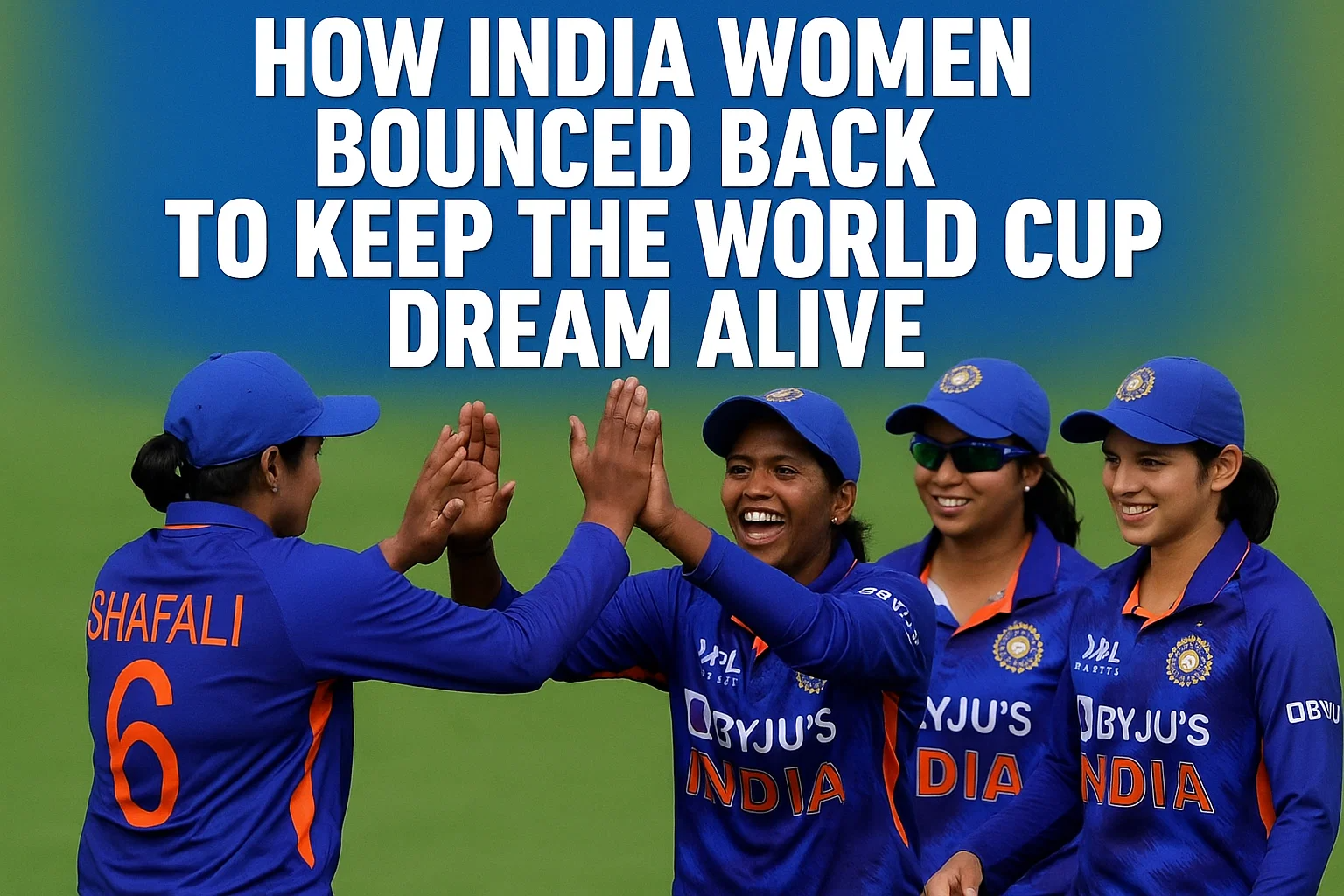
In the grand stage of world cricket, comebacks are what legends are made of — and the Indian women’s cricket team just scripted one of their finest.
After enduring a series of mid-tournament defeats that nearly shattered their ICC Women’s ODI World Cup campaign, India roared back to form with a spectacular victory against New Zealand at Navi Mumbai’s DY Patil Stadium.
That win wasn’t just about securing a semi-final spot — it was about resilience, belief, and rediscovering the fire that defines champions.
A Do-or-Die Clash: India’s Moment of Reckoning
For Team India, the match against New Zealand wasn’t just another game; it was a battle for survival. Having lost three matches in a row — to South Africa, Australia, and England — the team’s campaign was hanging by a thread.
Critics questioned their mindset, strategy, and technical execution. Were they losing their nerve under pressure? Were they unable to finish games?
But under the lights of DY Patil Stadium, all those doubts were crushed by a performance full of grit and grace.

Smriti Mandhana and Pratika Agarwal: The Power of Partnership
The turning point came through a record-breaking 212-run opening partnership between vice-captain Smriti Mandhana and rising star Pratika Agarwal.
Smriti, the elegant left-hander, was in her element — timing the ball with precision, finding gaps effortlessly, and punishing loose deliveries. Beside her, 25-year-old Pratika Agarwal showcased maturity beyond her years. Her temperament, shot selection, and ability to rotate strike complemented Mandhana perfectly.
This partnership didn’t just provide runs; it restored confidence. It reminded the world why India’s top order is considered one of the most formidable in women’s cricket.
By the time Jemimah Rodrigues walked in and added a vibrant unbeaten half-century, India’s total soared to a record 340–3 — the highest group-stage score of the tournament.
Rain, Duckworth-Lewis, and New Zealand’s Struggle
As rain interrupted play, New Zealand’s revised target was set to 325 under the Duckworth-Lewis method. However, their chase never really took off.
The Indian bowlers — Renuka Singh, Kanto Goud, and Shree Charani — struck early blows, dismantling the Kiwi top order. Every time New Zealand tried to rebuild, India found a breakthrough.
The result? A comfortable 53-run win before more than 25,000 cheering fans, marking the highest-ever group stage attendance in a Women’s ICC tournament.
India’s Journey So Far in the Women’s ODI World Cup
| Match | Opponent | Result | Key Performers | Remarks |
|---|---|---|---|---|
| Match 1 | Pakistan | ✅ Win | Mandhana (85), Deepti (3 wickets) | Dominant start |
| Match 2 | South Africa | ❌ Loss | Harmanpreet (62) | Lost by 3 wickets |
| Match 3 | Australia | ❌ Loss | Mandhana (74) | Narrow defeat |
| Match 4 | England | ❌ Loss | Rodrigues (45) | Lost by 4 runs |
| Match 5 | New Zealand | ✅ Win | Mandhana (101), Agarwal (98) | Record win |
| Upcoming | Semi-Final | — | — | Redemption awaited |
Bouncing Back Stronger: The Mental Game Behind the Win
Cricket is often called a game of technique, but for India, the real battle was mental.
After three consecutive losses, the dressing room atmosphere was tense. Analysts and former players pointed out issues in fielding, over-dependence on top-order batters, and lack of composure during chases.
However, the coaching staff worked on mental resilience, encouraging the players to focus on their strengths.
Smriti Mandhana, in a post-match interview, said:
“We never lost belief. We knew one strong performance could change everything — and it did.”
That self-belief became the cornerstone of India’s revival.
Learning from Defeats: Turning Pain into Power
Each of India’s earlier defeats had a lesson:
-
Against South Africa, India failed to defend under pressure.
-
Against Australia, they couldn’t finish key overs smartly.
-
Against England, they fell short while chasing despite being in control.
These weren’t blowouts; they were heartbreaks — narrow losses that exposed small weaknesses.
But by addressing these tactical errors and boosting team communication, India transformed those painful moments into a roadmap for victory.
The Semi-Final Equation: What Lies Ahead
The semi-final line-up remains competitive, featuring Australia, England, South Africa, and India. Ironically, these are the same three teams that handed India their group-stage defeats.
That means India’s road to glory runs straight through its past — a symbolic test of growth and redemption.
| Team | ICC Ranking | Tournament Record | Strength | Weakness |
|---|---|---|---|---|
| Australia | #1 | Unbeaten | Deep batting lineup | None visible |
| England | #2 | 3 Wins, 1 Loss | Tactical discipline | Middle-order inconsistency |
| India | #3 | 2 Wins, 3 Losses | Strong top order | Inconsistent bowling depth |
| South Africa | #4 | 2 Wins, 1 Rain-out | All-round ability | Pressure handling |
To lift their maiden title, India must beat at least two of these powerhouses. But with momentum now back, fans believe — this could finally be India’s year.
Key Players Who Are Redefining India’s Campaign
-
Smriti Mandhana (Vice Captain)
The poster girl of Indian cricket continues to dominate bowlers worldwide. With her commanding presence and cool temperament, she remains India’s most consistent performer. -
Pratika Agarwal (Opening Batter)
From a promising youngster to a match-winner — Pratika’s transformation has been spectacular. Her ability to anchor innings gives India stability. -
Jemimah Rodrigues (Middle Order)
Dropped earlier for poor form, Jemimah bounced back with an unbeaten half-century against New Zealand, silencing critics. -
Harmanpreet Kaur (Captain)
Though her form dipped mid-tournament, her leadership and tactical acumen have been crucial in holding the team together. -
Deepti Sharma, Amanjot Kaur & Sneh Rana (All-Rounders)
Their contributions with both bat and ball give India the balance every winning side needs. -
Renuka Singh, Kanto Goud & Shree Charani (Bowlers)
Reliable with the new ball and effective at the death, this trio adds the cutting edge India lacked in earlier matches.
What Experts Are Saying
Cricket pundits have praised India’s comeback as one of the finest in recent women’s cricket history.
Former Australian legend Lisa Sthalekar remarked:
“This is not just a comeback — it’s a statement. India have found their rhythm at the perfect time.”
Meanwhile, commentators noted that India’s fielding intensity and strategic discipline against New Zealand were miles ahead of their earlier performances.
The Road to Redemption: What India Must Do Next
To keep the World Cup dream alive, India must:
-
Maintain top-order partnerships like Mandhana-Agarwal.
-
Strengthen middle-order consistency.
-
Find a reliable sixth bowling option.
-
Stay mentally composed in crunch overs.
-
Focus on fielding improvements and sharp catching.
Each of these elements can make or break the semi-final clash.
Why This Comeback Matters for Indian Women’s Cricket
Beyond scores and stats, this victory carries emotional weight. Women’s cricket in India has seen explosive growth over the past few years — the WPL, sponsorships, and fan engagement have risen dramatically.
This comeback serves as inspiration for young girls across the country, proving that perseverance can rewrite destiny.
When 25,000 fans cheer your name at a stadium, you know the nation is behind you.
Frequently Asked Questions (FAQs)
1. Who were the top performers in India’s victory over New Zealand?
Smriti Mandhana scored 101, Pratika Agarwal added 98, and Jemimah Rodrigues remained unbeaten with 57 runs.
2. How did the weather affect the match?
Rain caused a delay and reduced New Zealand’s target to 325 via the Duckworth-Lewis method.
3. Has India ever won the ICC Women’s ODI World Cup?
No, India has reached the finals twice — in 2017 (lost to England) and 2020 (lost to Australia) — but hasn’t won yet.
4. Which teams are likely to play in the semi-finals?
Australia, England, South Africa, and India have qualified for the knockout stage.
5. What is India’s biggest strength going into the semi-final?
Their top-order batting — especially the partnership between Mandhana and Agarwal — is their strongest weapon.
6. What challenges does India face in upcoming matches?
Consistency in bowling and handling pressure in crunch moments remain the biggest hurdles.
Conclusion: The Dream Rekindled
The story of India’s Women’s World Cup journey isn’t just about cricket — it’s about courage, resilience, and the power of self-belief.
From despair to dominance, Team India’s turnaround is a masterclass in fighting back when everything seems lost.
